Saturday, 25 April 2015

Experimenting with Drawing on Frames

After producing some A4 watercolour and ink animal portraits, I felt they needed an element of imagery which reflected the issue faced by each species. Therefore, not wanting to spoil the original imagery, I directly drew onto the glass in permanent marker. The left illustration reflects deforestation with the stumps of trees and the right illustration reflects the illegal pet trade of orang-utans with the bars. Scratching into the thick lines gives the impression of depth for the bars and also adds texture. 


Even though these are quite effective for creating a statement about the issues, the harshness of the black draws attention away from the illustrations and the subtly of watercolour is subdued. 

To make the illustrations more prominent and the focal point in the exhibition, white frames could be used, clear with the original illustrations. This will highlight the illustrations and raw texture in the pieces without distracting from the sensitive content.

Tuesday, 21 April 2015

Combining Digital and Traditional

As experimental development, I used my own primary source imagery combined with illustrations to create new ideas and themes. These have been heavily manipulated in Photoshop so the quality may not necessarily be there although these could be used as reference to create new illustrations.

Here I have used a photograph of bars combined with an illustration to make it appear as though the elephant is trapped and caged.

Left: The original photograph.

Below: The manipulated imagery.


These images reflect the trauma of the Asian elephant when faced with threats from the human race. Rather than elephants being physically caged, my intention is for the cage for be a symbol of how such a large animal is made to feel demoralized and trapped in a number of ways. This could reflect on how elephants are used within the tourist industry in Thailand or even how they are kept behind the scenes of a circus. 

Intentionally, the elephant appears vulnerable and lost. Perhaps this is the only elephant left before they become a long lost memory into extinction? The red hues reflect violence and danger, a sense of darkness which is the elephants impending fate.


Using the same elephant illustration, I superimposed the animal into a forest scene. The forest scene is manipulated from a primary source photograph and put into a new context. The in the left image the elephant seems vulnerable in its own habitat whereas in the right image the elephant seems to be fading away. This sense of fading reflects the threat of extinction through habitat loss. Whilst the habitat is replaced and preserved, the elephants and forced to survive elsewhere, or not at all...


 Using an ink illustration, I thought about a comment I had during the formative assessment- why not add a background? Whilst I feel white space encourages the viewer to pay closer attention to the main subject, I decided to use a primary source landscape photograph to provide a sense of context to the image. The darkness of the landscape highlights the elephant slaves whilst the red tones in the sky imply a sense of danger and foreboding. Where are the elephants being taken? What is their fate?


These illustrations were manipulated in Photoshop and given a simple forest-like background. This background was painted digitally and fills out the image.

Overall, I believe these experiments were a success in how they reflected the threats of extinction and providing imagery which is more thought-provoking for the viewer. The colours are vivid and the use of photography brings stronger compositions. However, the manipulation in Photoshop can appear over-worked so it could it effective to replicate similar imagery in traditional media.

Sunday, 19 April 2015

Introducing Orang-utans

To progress on the development of my project, I have decided to focus on threats to orang-utans in the wild. The threats include habitat loss through deforestation, the illegal pet trade and agriculture for palm oil. These facts were all sourced from the World Wildlife Fund website and Orangutan Conservancy.

The choice to focus on orang-utans came from when I initially looked into endangered species of the Sumatran forest. Then when I went to Chester Zoo to take primary source imagery I felt I sympathised with the animals, especially one who was by the glass and looked to somber and sad.


Although the animal was hard to photograph due to the reflection from the windows, I cannot explain how emotional this made me feel, how sad it was to see such a grand animal being observed in a cage which resembled not even a small portion of his original habitat. This made me want to make a change even more through my illustrations so that perhaps people will become aware that these animals were put on the Earth to achieve more than be viewed as an object in a zoo. If people are ignorant to the threats of orang-utans in the wild then they will be destined for a life in containers until they eventually fade from this planet entirely.

Here is a couple of experimental illustrations defining the character of this beautiful creature:


Saturday, 21 March 2015

WWF Donation Box

As part of the final exhibition, I wanted to include a World Wildlife Find donation box alongside my displayed work to encourage people to donate to the charity. Choosing the WWF to fund raise for was an easy decision as I have based much of my research on their website. My aim is to hopefully encourage people to want to make a change through my artwork and therefore donate as little as possible. 


After contacting the WWF through Twitter I emailed the contact given and was pleased to received a positive response and it seems that it will be possible to get a couple of donation boxes.

I gave them my address and received the boxes soon after I contacted the charity. Here is one of the boxes pieced together, I received two others which I can display with my exhibition.


Friday, 6 March 2015

Inspired by Campaign

Researching animal rights has made me realise how huge the problem is not only in the UK but also worldwide. Since the completion of my dissertation about animal rights, I have taken it upon myself to stop eating meat for as long as I can in aid of my project. As an avid meat eater it will be interesting to see how long I will be able to cope before I run out of meals... The point is, through research it has changed my own viewpoint of the way in which animals are treated my humans and therefore I hope to transfer this desire for change through my illustrations. A small step in the right direction is better than being ignorant to any of the issues at all.

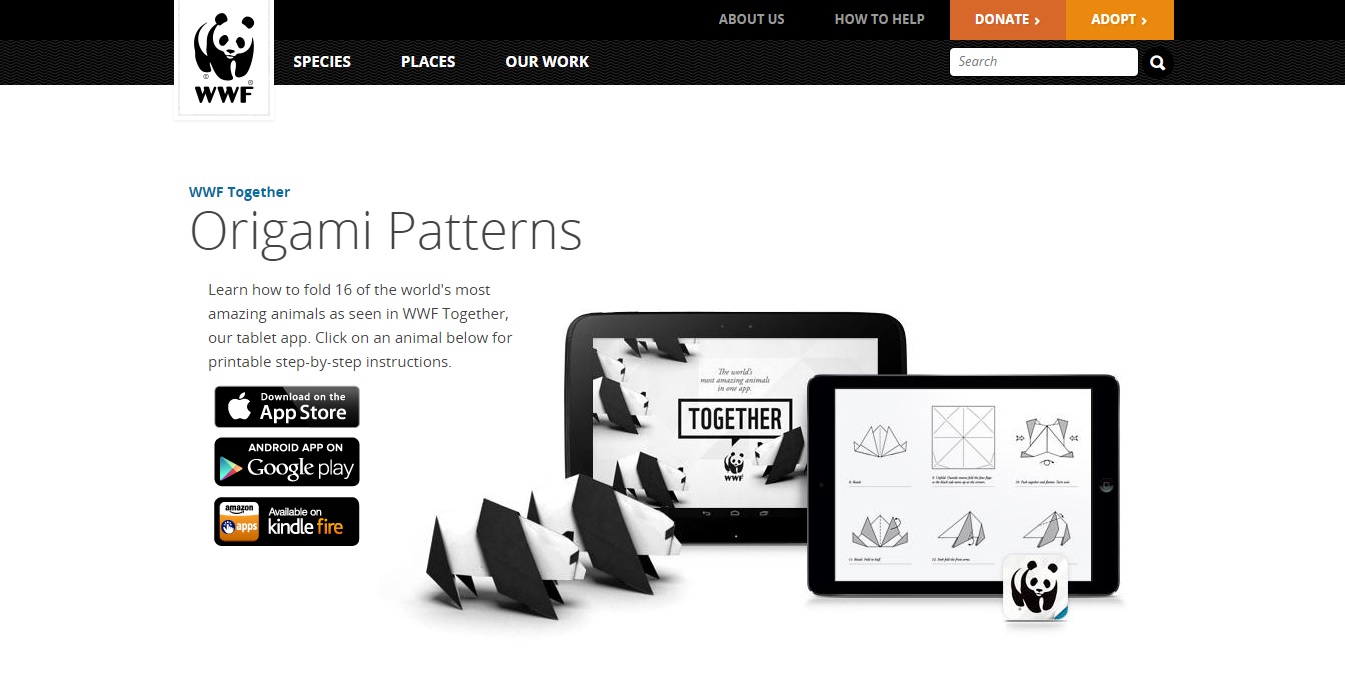
Since my new project is about animal rights in regards to global issues, specifically endangered species, I found an inspiring way of campaigning by the WWF.

 WWF Origami Campaign
WWF Origami Campaign


The idea here by the WWF is to generate an interactive campaign method to raise awareness about the issues with a main aim for a donation from the viewer. This simple yet innovative campaign idea not only involves the viewer but allows them to make a direct connection with the animals who are endangered. Varying levels of difficulty mean that the origami is aimed at a range of younger and older viewers. The effort put in to making the origami proves to the viewer how little time it takes to make an impact through giving just a small amount of their time. Involving the viewer is an effective tactic for keeping the viewer interested and making the app available on a variety of technology devices aids the campaign to be accessible to a large amount of potential viewers who may donate to making a change.


Tuesday, 24 February 2015

Ideas for an end product

As an illustrator it is important to find a compatible context which is suitable for the topic. In this case I needed to figure out the context for the topic of 'endangered species' which would help me communicate in the best form possible. I have decided to step away from animation which I was leaning towards in my last project. This is due to the fact I would need to learn a whole new set of skills within a couple of months, and as I want my best work included in my final major project of university I felt that it was important to develop on skills I already have rather than learn new ones.

Therefore, I would still like to incorporate campaign in my work and making them more effective by enhancing my traditional and digital skills. The final product I would like to create is a campaign brochure as I feel it would allow me to explore the issues and causes of endangered species in the most effective way and hopefully begin to make a change. This will require research into brochure design and the content included, which I will do along side creating concepts through illustration.